Chronic traumatic encephalopathy (CTE) is having a material and serious impact on the quality of life enjoyed by Australian rules football at the lower levels too, a new Four Corners investigation has found.
Perhaps most damningly for those tasked with stewarding the nation's pastime, the recommendations of medical professionals have been ignored for five years, despite concussion - the AFL's second most common injury - remaining front of mind.
Two Victorian coroners, in the wake of the tragic deaths of Danny Frawley and Shane Tuck, recommended the AFL establish a formal partnership with brain banks, that the condition may be understood with greater clarity.
Both of the deceased hardmen were found to have had the condition after their deaths.
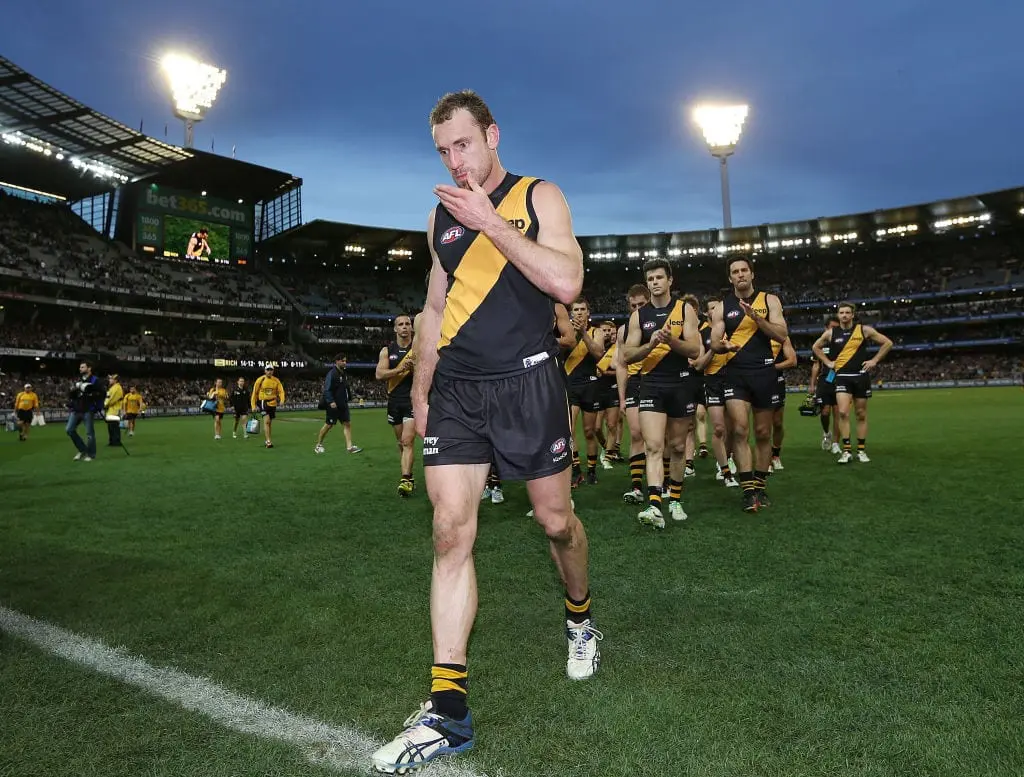
In the five years since the recommendation was first made, the AFL have not acted on it, the investigation found.
As yet, there has not been a test or a scan developed that can diagnose the condition in a living person, delineating prevention and research as obvious priorities.
Associate Professor Michael Buckland, from the Australian Sports Brain Bank, said his latest findings of CTE in Australian Rules players were alarming, particularly with the brain disease being diagnosed in younger footballers who only played at amateur levels.
A "disturbing association" between CTE and suicide has emerged, but more evidence to "establish a direct causal link between the two" is required, hence the importance of the as-yet-ignored recommendation of a partnership between the code and brain banks.
The parents of one such amateur footballer, the deceased Nick Lowden, a former Casey Demon and Norwood Redleg, spoke to the investigation, detailing their harrowing grief and the rapid decline into mental anguish experienced by their beloved son after a concussion sustained in a 2017 juniors match.
Kerry and Tony Lowden, who hadn't heard of CTE prior to their son's death, were left shellshocked by Laura Kane's tone deaf response to Nick's passing.
Kane insisted the league was doing enough to educate players, despite parents of amateur footballers, like the Lowdens, not being familiar with the condition.
"Those stories are incredibly sad. They're sad for anyone who's close to those people," Kane told the investigation.
"What it tells me is that we all need to learn and there's more to learn about CTE and understanding the link between contact sports and CTE."
Damningly, however, she said it isn't necessarily the AFL's job to communicate research findings.
"Our job is not to communicate every single aspect of risk that exists in our game," she says.
Danny Frawley's widow, Anita, disagrees, putting the onus on the AFL to deliver stronger leadership around head trauma, in a statement provided to the ABC.

"Why is the football community still without a clear, nationally recognised pathway to support vital brain research?" she asked.
"This is not about blame, it's about leadership, accountability, and player welfare. The football community deserves answers. More importantly, players, past, present, and future, deserve action."
The investigation also spoke to Dr Ann McKee, one of the world's leading experts in CTE, who was particularly strong in her stance on the AFL's inaction.
"There's a potential financial benefit of pretending that these sports don't have risks, but I think the scientific data is incontrovertible," she told the program.
"We're waiting now for Australia to catch up to what I know is very bad news, very inconvenient news, but if we want to move forward and make these games safer … we have to do something about this."