Now that the grand final is decided, we all look ahead to trade week, and – as a Collingwood supporter – I look forward to Collingwood's great renovation.
Not a rebuild. God forbid they rebuild their list – with Tasmania coming in, a dearth of top picks, and little to trade out, they don't have the license to rebuild without it becoming some protracted minefield.
So it's a renovation. Get in some older players. They might only be there a year or two. But they'll provide service and be a bridge to the next generation … or the next batch of older players.
Is this tenable, though?
Have you seen the movie Moneyball? In it, the Oakland Athletics struggle to compete against the bigger, wealthier baseball clubs. Whenever the Athletics find a potential star, one of those big clubs poaches them with an offer the Athletics can't match. To compete, the Athletics redefine the statistical metrics that qualify what good players are and target recruits others are dismissing. After a rocky start, they race up the standings.
And this feels like what Collingwood's attempting.
Redefining list management.
Go back to the 1970s and particularly the 1980s, clubs bought success. The draft and salary cap changed that. Clubs couldn't just raid other clubs. The salary cap ensured if you spent big on too few players, there'd be a talent disparity across the list. The methodology changed. Clubs now started building through the draft – accumulating lowly finishes, top picks, and hoping they'd score the best next generational talent.
Now there's no guarantee to any of this. The draft remains speculative. You just need to look at Murphy Reid going at 17, or Tom Stewart at 40, or Lachie Neale at 58, to see that you can't precisely measure potential. Top picks haven't met their expectations or have been levelled by injuries. In retrospect, how many number one picks would still be number one?
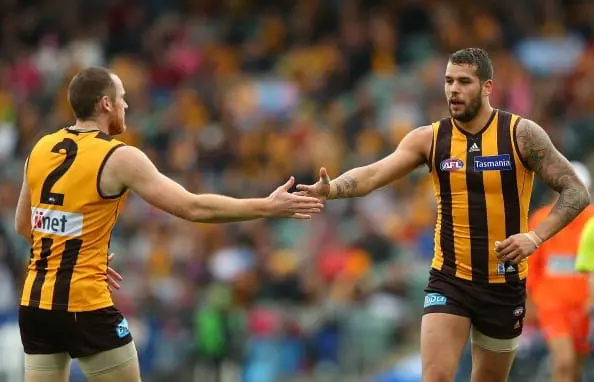
Let's flashback to Hawthorn and Richmond in 2004. Richmond picked up Brett Deledio (1), Richard Tambling (4), Danny Meyer (12), Adam Pattison (16), and Dean Polo (20), while Hawthorn selected Jarryd Roughead (2), Lance Franklin (5), and Jordan Lewis (7).
For the Tigers, only Deledio gave close the return you'd hoped for, while each of those Hawks had incredibly distinguished careers, with Roughead and Lewis playing in 4 flags, and Franklin in 2 before crossing over to the Swans.
This is the thing: if you get it right, your club can enjoy dynastic domination. And the better the pick, the better the chance you will find that gun.
Flashback to Brisbane 2001-02-03; Geelong 2007, 2009, 2011; Hawthorn 2008, 2013-14-15; Richmond 2017, 2019-20; and now Brisbane has come around again with 2024-25-26.
All these clubs built initially through the draft. There are those that will say that some were lucky with father/sons. Geelong scored Gary Ablett Jnr, Matthew Scarlett, and Tom Hawkins; while the Lions have found the Ashcroft brothers and Jaspa Fletcher. But that still highlights the point of young talent.
Any deficiencies were then addressed with judicious trading. Geelong needed a ruckman and went out and got Brad Ottens; Hawthorn needed a key defender and went after the Bulldogs' Brian Lake, then also brought in Ben McEvoy from St Kilda to ruck; the Lions brought in Essendon's Joe Daniher as a key forward, and an elite defensive mid in Josh Dunkley from the Bulldogs. More recently, they've traded for Bomber Sam Draper and Eagles' captain, Oscar Allen. These are just a few examples.
On the flip side, how have the renovators gone?
Can you name one club that's had prolonged success?
The immediate response will be the Cats. Since 2011, they've recycled, patched up their team, and regularly made finals, but through the 2010s just how often do you think they were a genuine chance of pinching a flag? Some will counter that you have to be in it to win it, but ultimately, we're in a results-based industry, and they weren't able to get it done through multiple campaigns.
They saluted in 2022, but that was finally after bringing in elite talent like Jeremy Cameron and Patrick Dangerfield before him, and finding some gun talent in the draft. Cameron's a bit more than a recycled talent, and speaks to the need for elite talent rather than valiant role players.
In any case, 2022 is now four years gone. Have the Cats won another flag since? Have they enjoyed that dynastic success of the Hawks, Tigers, Lions, or even the Cats that were built from the draft over twenty years ago? Do any of us expect them to?
You see the renovators will often punch above their weight before the bottom drops out. The Lions did it after their threepeat, bringing in Brendan Fevola, Amon Buchanan, Brent Staker, Matt Maguire, and Xavier Clarke. Hawthorn cut Luke Hodge, Sam Mitchell, and Jarryd Roughead, and replaced them with Tom Mitchell, Jaeger O'Meara, Ty Vickery, and Ricky Henderson. The Tigers won their three flags and tried to remain relevant by bringing in Tim Taranto and Jacob Hopper.
How's that worked for these clubs? This is not to impugn those players. They're good players. Tom Mitchell won a Brownlow. Brendan Fevola kicked 99 goals in a season. But in that time, in that place, were they the difference between their club and continued success? Did they contribute to their clubs building a dynasty?
Let's look at a club that often renovates: St Kilda. Remember when they brought in an aged, broken-down Dan Hannebery, as well as Zak Jones, Paddy Ryder, and Brad Hill, and more recently Tom de Koning, Jack Silvagni, Sam Flanders, Liam Ryan, Leek Aleer, Liam Henry … well, there are a lot of names.
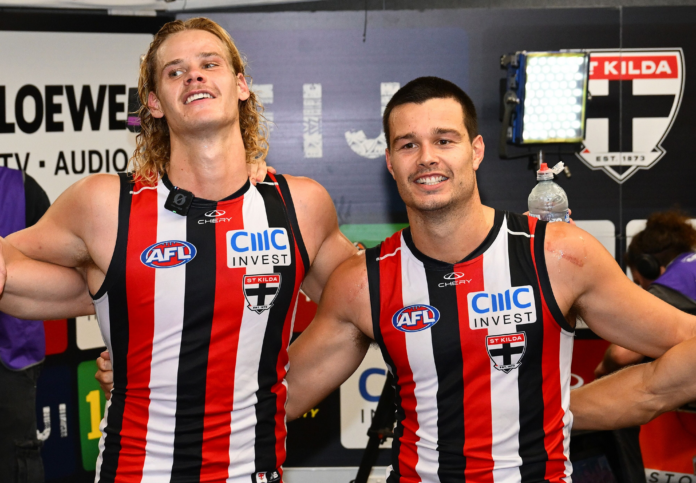
Again, these are good players, but are they genuinely moving the needle at the Saints closer to a flag? How many of them were also needed? De Koning is a fine young player and ruck prospect, but so is Rowan Marshall. Could Jack Steele have done the job they brought Flanders in to do? Meanwhile, their best player, Nasiah Wanganeen-Milera, was taken pick 11 in the draft. That's illustrative, isn't it?
Clubs can get caught in the habit of thinking they're not that far off, that they're just this player and that player away from contending, that they're closer than they think, but they'll tread water – every time – and then it falls apart as their lists are exposed as pockmarked and held together by too few. Then they're left going to the draft anyway because they realise, belatedly, they were never that close at all.
In the modern era, no renovating club has enjoyed long-term premiership success. You might want to highlight Geelong's run in the finals again. I understand supporters can appreciate a year where their team is competitive, where games are fun to watch, but it is still about premierships. I bet you can list every premier from 2011 – 2020, but you couldn't list every Geelong finish.
As for Collingwood? They will bring in Lachie Neale and Jesse Hogan, but they've done this renovating thing before. They were 'Moneyballing' before the Athletics. The Pies did it under Tommy Hafey, and made grand finals in 1977, 1979, 1980, and 1981, yet didn't win a single one. They did it prior to that when the club's mentality was all about playing for the jumper, and any time a recruit pulled it on, they went from a good player to a superstar. Various incarnations were good enough to compete, but not good enough to go all the way. The whole 'Colliwobbles' era was built on it.
As for the Oakland Athletics, for all their seasonal success, for all their redefinition of the talent pool, they were never good enough to win a pennant.
Surely, there should be a lesson in both examples.
Surely.