


Tasmania's Head of Development Nigel Lappin was eager to reunite with Ken Hinkley after the pair worked together at Geelong 17 years ago.
Lappin was appointed the Devils' development chief just two weeks after Hinkley became the club's inaugural senior coach in July.
But Hinkley wasn't the only familiar face drawing Lappin to the expansion club, with a former Essendon coach playing a crucial role in his recruitment.
"I've got a really close relationship with a couple of people that work here," Lappin said.
"So Matty Knights has been involved with the club in the last 12 months, so he was keeping me up to date with what he was doing, and every conversation I had with him, I was pretty excited.
"I had a conversation the year before with Brendon (Gale), just asking if I had any interest at some point. And then, probably, when Ken came on board, I worked with Ken for 12 months at Geelong. He's a wonderful person with great values. Someone I've wanted to work with again one day, and it seemed like the right time with the amount of time I spent at Geelong.
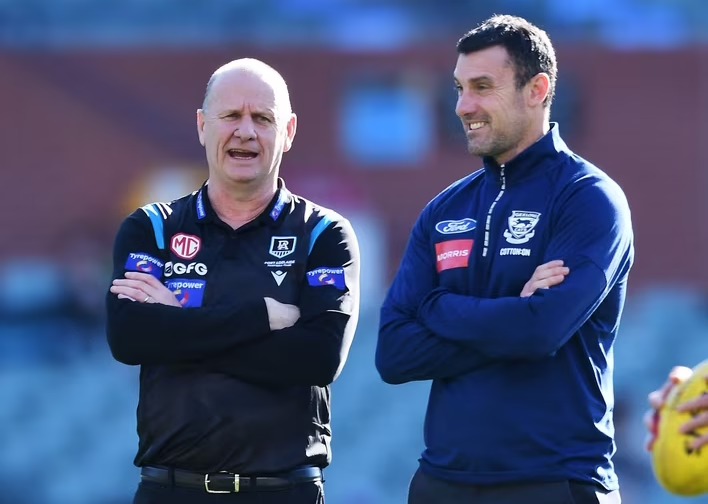
"And then the staff I've already met a few times when down here in Tassie through other people, I feel like they're trying to build something really special, and it reminded me what Geelong has been through, and the type of environment they've been able to build.
"I got pretty excited pretty quickly."
Knights has spent the past 12 months working as the club's inaugural Academy Development Coach, working with VFL players and assisting their football journeys.
Lappin has built a reputation as one of the AFL's most respected development coaches after spending the past 18 seasons with Geelong, following a successful playing career with Brisbane.
The opportunity of helping build an AFL program from the ground up was a major attraction for the former Lions star, while the prospect of uniting an entire state added to the appeal.
Lappin has outlined what his role will involve at the Devils, including his approach to developing players across the three distinct phases of the game: attack, contest and transition.
"Initially, have a really big hand in the (development) program that (Tasmania) do," Lappin said.
"I'm a big believer in going after fundamentals, designing some concept drills. And we've done a fair bit of research with that. Ken has been involved in a different club. I've been involved in a different club as well.
"But we've also been consulting the Tassie people on what type of product you want to see, and I can guarantee the players we've got in are going to be pretty exciting to watch.

"So my main role is to make sure those players are developing really well. We're building a really good culture in the building, so when they come to work every day, they're excited and love coming to work.
"There are three distinct phases in the game. There's attack, contest and transition; they know how to play those roles really well."
But for Lappin, developing players is about more than simply improving their footballing ability.
His coaching philosophy is to give the players the tools and confidence to "stand up on their own" when it matters most.
"I've got some key leadership philosophies I try to work by, and it's mainly a four-step process," he said.
"The first one is: how do we set a vision? How do we then embody that vision? That's us included as coaches. How do we make everyone in our organisation, particularly the players, feel valued? Then it's trying to make the players as independent as they can.
"They always want you as a mentor, but my main role is to make sure on Grand Final day, these guys can stand up on their own two feet and don't need me as a coach."