On Monday, AFL media personality Dan Gorringe went after Gerard Whateley, Matthew Lloyd and Leigh Montagna after they went after him after he released audio of former captain Sam Docherty going after Carlton after a Round Zero Blues capitulation.
A silly sentence to sum up a silly issue.
Like live commentary of a boxing match, news stories were written and updated to cover every punch.
It divided the AFL world.
Gorringe's cult following of mostly young footy fans ate up the content and it quickly went viral.
Media organisations, too, got a free story to run. A prominent former player going after their old club is gold in a newsroom.
Opinionists and media analysts almost exclusively sided with Docherty, with many loud voices terming Gorringe's behaviour unethical, both personally and professionally.
The saga prompts a wider discussion about the rise of so-called influencer platforms which are penetrating the AFL landscape.
Given their reach, these creators have to be held to the same standards as traditional media.
Australian media is regulated by the Media Entertainment and Arts Alliance's Code of Ethics which contains 12 standards.
For qualified journalists, the standards are mostly common-sense, relating to honesty, fairness and independence, with complaints able to be lodged if appropriate.
The Australian Press Council, similarly, has a statement of principles which must be upheld, and a process for complaints.
The Gorringe saga highlights that without a basic understanding of journalism or the media industry, issues can quickly arise and trust eroded.
The eighth standard stipulates that ‘fair, responsible and honest means should be used to obtain material'.
Failing to communicate the purpose for asking for information or disclosing that what he said would be directly on the record contravenes the standard.
Gorringe highlighted in the aftermath that Docherty has not expressed any discontent towards him, but only he himself would know how he felt about the saga. As one of footy's good guys, he's unlikely to express disappointment publicly.
The crux of the issue, though, is not how Docherty felt, but a severe lack of understanding about how the media needs to work.
Mostly, Gorringe has made light of the incident in the aftermath, but how would he have liked it if the news organisations which quoted Docherty didn't attribute his podcast?
Akin to his incident, that would have failed to uphold the Code of Ethics.
Fans might laugh and many will say that old-school journalists are overreacting, but such incidents reinforce a long-held distrust many have with the wider media landscape.
So big is the mainstream media in the sport that there are more journalists covering footy than there are AFL players and creators add another whole market of competitors.
With so many people in the landscape, mutual trust is a pre-requisite if fans want to continue to receive a mixture of well-scrutinised information and absorbing content about the protagonists of the game.
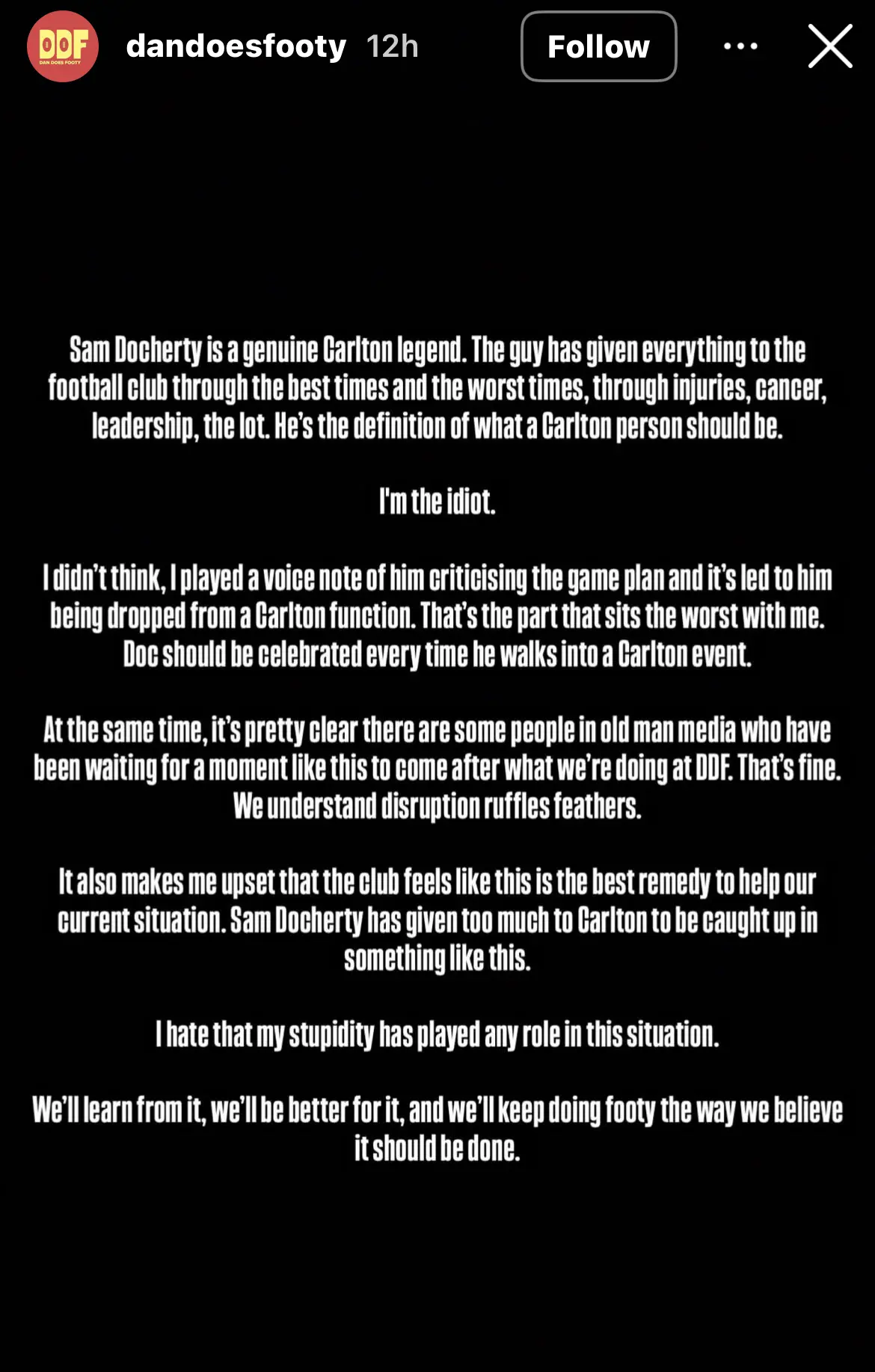
If you missed the incident at heart of the debate, Gorringe released an audio message sent to him by former captain and teammate Sam Docherty slamming Carlton's performance on Thursday night, with Docherty unaware the audio would be released verbatim.
He stood by his comments but apologised for his language. Carlton banned him from speaking at a club event as a result of the comments. Gorringe expressed remorse for the impact his actions have had on Docherty via Instagram on Tuesday night, but stood his ground against 'old-man media'.
Despite this saga, it is important to note the significant role new-age media plays in the current footy landscape.
Platforms such as Dan Does Footy, Baseline Footy and Cench Footy aim to entertain and deliver the news in a way that is relatable, particularly for younger audiences, usually weaponising social media by attempting to create thumb-stopping content.
As traditional media organisations continue to roll out the same tired panel shows and increasingly understaffed newsrooms rely on press conferences and media opportunities where cliches are repeated, a tidal wave of content creators have seized an opportunity.
While newsrooms seek to inform, these platforms can entertain and analyse.
Media organisations have responsibility to provide coverage of 18 clubs and therefore can only capture the clearest storylines, with fan accounts seizing on the market for nuffies seeking much more granular analysis and in-depth content.
Increasingly, clubs are recognising the significant audience these platforms have, working with them to provide content which helps them sell their narrative.
Essendon invited a host of these creators to its media and content day in February and players embraced the opportunity to engage in conversations with supporters.
Essendon is not alone either, with the media landscape ever-growing and several club media managers across pre-season pointing out the increased emphasis their team is putting on working with such creators.
Of the several talking points from Essendon’s photo day today, the one most striking for me was the club’s openness to all forms of media - traditional and new-age alike.
Fans increasingly interact with modern content over traditional media and players enjoy it - win-win.
— Jonty Ralphsmith (@JontyRalphsmith) February 3, 2026
Even mainstream media has embraced these new-age creators, with Newscorp-owned Code Sports inviting a Carlton and Melbourne creator to write a column providing a fan's perspective of their club.
The AFL's own media arm, too, has cut staff as more focus is put on working with creators.It's all a positive for the sport, with audiences expanding and able to access footy content in greater and more varied ways than ever before.
It comes at a time where mainstream media face a constant uphill battle for accreditation and access to players, despite the Collective Bargaining Agreement stipulating players be made available in certain windows, which restricts their capacity to provide audiences with a point-of-difference. Therefore, the rise of new forms of content is a big positive for footy fans.
The freedom and independence of content creators give them a point-of-difference on mainstream media outlets, allowing them to appeal to a wider audience.
But these platforms need to recognise their own scope and accept the responsibility that comes with the fun.
Get set for the footy with the FREE Zero Hanger 2026 AFL Season Guide! Packed with 150+ pages of player profiles, team previews, insights and analysis, the 2026 AFL Season Guide is built for fans who want the full picture. Download your free Season Guide HERE.