Essendon and West Coast's wretched injury run in 2025 led to major overhauls of their high-performance group and the direction in which the two clubs want to head.
The Bombers suffered arguably the most unprecedented amount of injuries last year, which resulted in a record 15 debutants. As for the Eagles, coupling injury woes with the desire to improve and get the youthful group up to AFL speed saw Phil Merriman poached from Fremantle.
But over the past two years, exactly half of the teams in the competition have changed their strength and conditioning coaching groups for various reasons.
Carlton desperately needed new instruction, as the club attempted to settle down their injury troubles from 2024, replacing Andrew Russell with Sydney's Rob Inness. The Swans promoted Irishman Shane Lehane at the time.
Port Adelaide created a new position for Tim Parham in 2026, who will lead athletic performance in a unified aspect. The Power were hindered by a litany of injuries to key stars, ultimately preventing Ken Hinkley from one last finals.
Richmond's availability struggles in Adem Yze's first year in charge (2024) led the club to pursue Geelong mastermind Ben Serpell, who had a tremendous influence on the emerging Tigers in his first season in charge.
As a result, Adelaide, Fremantle, Geelong and GWS were forced into high-performance team moves.
But why?
The immense scrutiny and pressure on professional sporting organisations revolves around delivering results, and in the AFL, if you ain't first, you're last.
This, in turn, filters down to the high-performance staff.
Clubs that finish outside the top eight feel an immediate pinch to improve, believing that drastic changes must occur to rise up the ladder.
"Do you want to have the least amount of injuries and finish in the bottom three or four, or do you want to have some injuries and finish in the eight and have a chance?" former Collingwood sports science director David Buttifant told Zero Hanger.
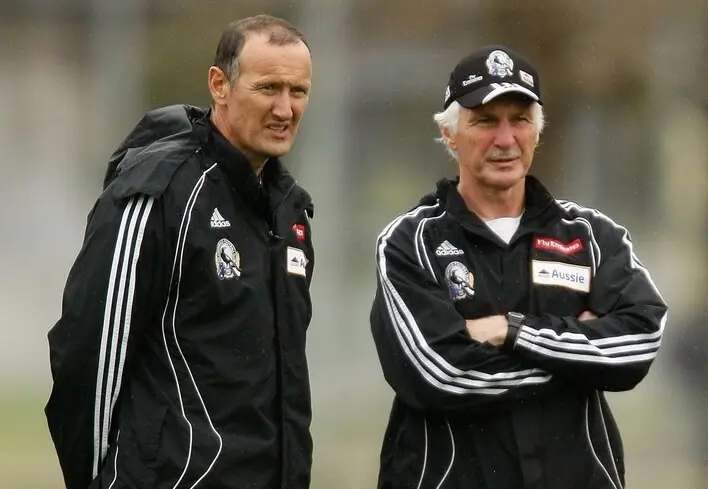
Buttifant spent 13 years at the Pies during a golden era under Mick Malthouse, helping the club reach four grand finals. He followed Malthouse to Carlton at the end of 2013.
"We're prepared to actually throw it at them and just to give our best shot to make the eight to get close to winning, or we go very conservatively, and we won't get injuries, but they won't be the same level as other teams. So you damned if you do, damned if you don't.
"You've got to create these kinds of adaptations, but that takes time, and also, you've got to ramp your load up as well. With that, you are predisposed to injury, which we're seeing. And because they've got less time, the pressure is on the high-performance staff because they're going to perform, and if they don't perform, they could lose a job.
"You start inhibiting opportunity to get better."
AFL clubs house at least 44 players on their list, and with that comes a lot of "diversity". Forwards need different programs than defenders. The type of role may demand different skillsets and strengths than others.
"We've got to ramp things up. And of course, that's what you do. You have to do that stuff, but it's got to be kind of managed individually, but it's not a blank canvas for everyone," Buttifant added.
"It's because you've got so much diversity on the list. You've got players who've been in the system for one year, and they're very raw, and your other players have been in the system for 14, 15 years, who have experienced a lot of history, very well-conditioned, and they can tolerate it from a physical and from a mental perspective. So the program has to be very much individualised."
Brisbane and Gold Coast have maintained a relatively consistent high-performance staff, led by Damien Austin (appointed at Lions 2016) and Alex Rigby (2018 at the Suns).
At the time of their commitment, both Queensland clubs were at the bottom rungs of the competition and were in desperate need of change.
The likes of Hugh McCluggage, Jarrod Berry, Ben King, and Izak Rankine had walked through the doors as they attempted to enter a new era.
Buttifant believes that "having faith in the program" can hold a club in good standing, allowing the high-performance staff to work alongside its players for multiple years before seeing results.
"It's just have faith in your system," Buttifant said.
"It's gonna take time. You know, we're probably two or three years off. Let's be patient. And having faith in the program and methodology you're gonna put in place. And this is, that's really important because it's when people start to deviate from the basic principles, then the injury starts to occur.
"And that's not uncommon. You may see that a first-year coach comes in and works hard enough, it's ramped up, and you change the model, and then they're not used to it, and then you start seeing these kinds of injuries start to actually occur. That's happened for years."
Get set for the footy with the FREE Zero Hanger 2026 AFL Season Guide! Packed with 150+ pages of player profiles, team previews, insights and analysis, the 2026 AFL Season Guide is built for fans who want the full picture. Download your free Season Guide HERE.